Chats
Talk to your second brain about a node, an item, or nothing in particular.
Overview
Some questions you would normally take to the colleague who has been around the longest. What do we know about this client? Which of these two venues did we like last time? Why is there a prep task on my Thursday? A chat is that conversation, with your second brain: ask it what you know, have it work through a decision with you, or ask why it suggested something — and it answers from everything you keep.
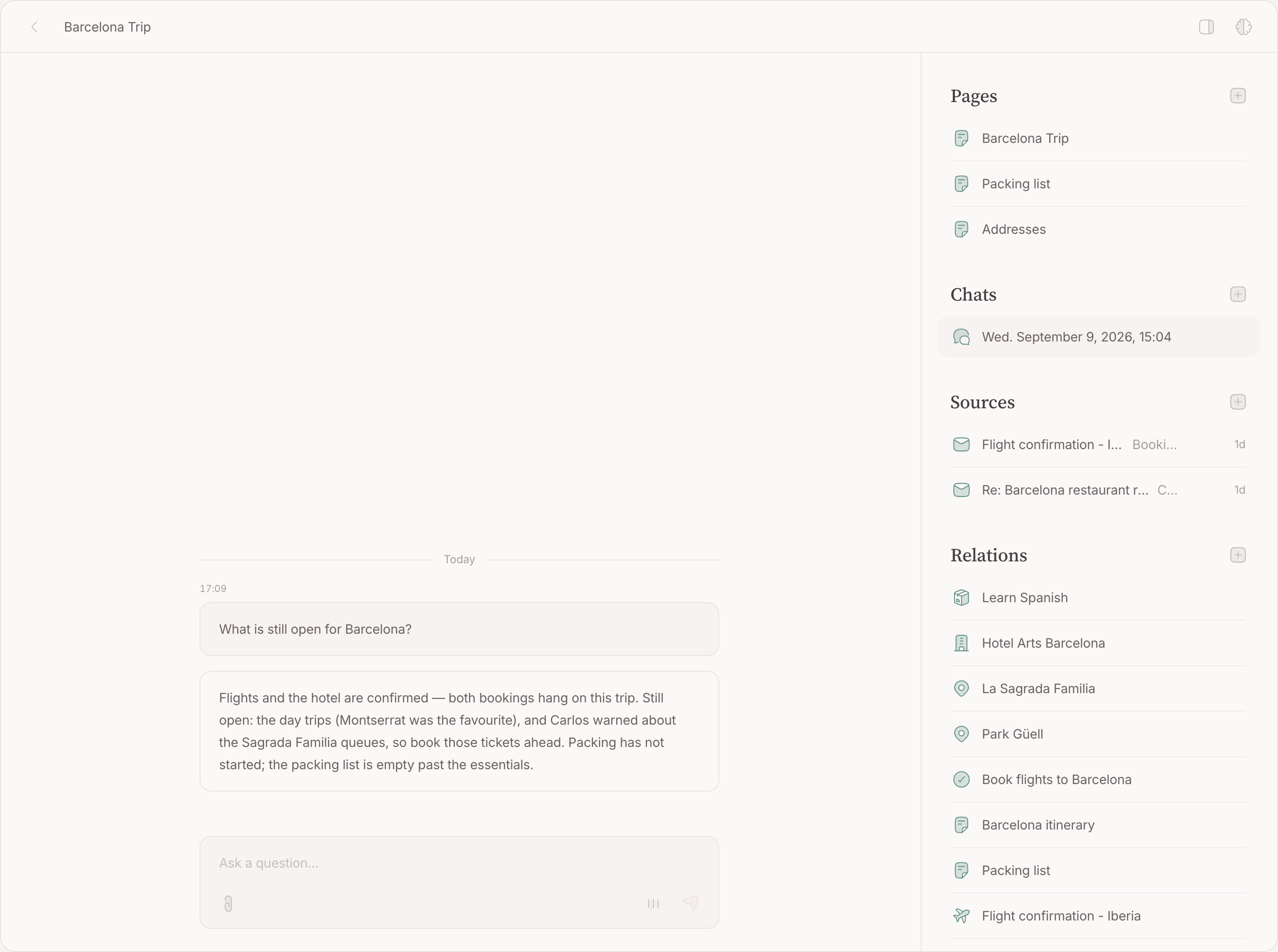
A chat stays where it happened: start one on a node and it hangs on that node afterwards, in a section of its own beside the sources, so the thinking sits where the subject is.
Basics
Start one
- On a node — from its chats section. It opens in place, so the node stays in view.
- On an inbox item — your second brain already read what arrived, and that reading is itself a conversation you can reply to.
- About nothing in particular — a chat of its own, with your whole second brain as context.
Ask it to do something
It can act while you talk. In a chat on a node, that node is the work: ask for a new status, a sharper title or a page in its note, and it is done, with the answer saying what changed. Everything else — a new node, a task, an event, a draft mail — it sets up as a proposal , decided as a whole and covered on the next page. The answer says what it set up; the proposal itself is not in the chat but waits in your Inbox . It does not act behind your back.
Come back to one
A conversation that has an answer you have not read carries a marker until you open it. A chat you started lazily is only minted once you actually say something, so backing out of one leaves nothing behind.
Where the thinking lands
A chat is where you work something out; it is not where the answer should stay. The graph is what your second brain and every later search read — a conclusion that lives three chats deep is one you will reconstruct instead of reread. So end a chat that settled something by letting it settle: have it write the decision onto the node — straight away when the chat is on that node, as a proposal to carry out when it is not — or write it there yourself. The chat stays hanging on the node as the trace of how you got there.
- Not the choice of venue buried in Tuesday's conversation, but the venue on the party's node — with the chat beside it for the day someone asks why not the other place.
- Not a chat as the only record that a thing exists, but a node for the thing, made from the conversation. Talking about something is what earns it a node, the same way a mail or a thought does.
The same division decides when to chat at all. When you already know the shape — the fact, the task, the line — write it on the node; a detour through a conversation adds nothing. Chat when you do not: to compare, to remember, to find out what the question even is.
FAQ
Do chats show up in my Inbox?
No. A chat is not a source: it does not arrive, it happens — and it never queues there.
Can I ask about something I did not write down?
You can ask anything; the answer is only as good as what you keep. That is the honest version of "a second brain" — it thinks with your material, not instead of it.
Does a chat change what it knows about me?
It may propose to. A conversation that surfaces a lasting preference can end in a proposed update to your context , and that waits for your yes like everything else.