Context
What your second brain knows about you before you say anything — and how to correct it.
Overview
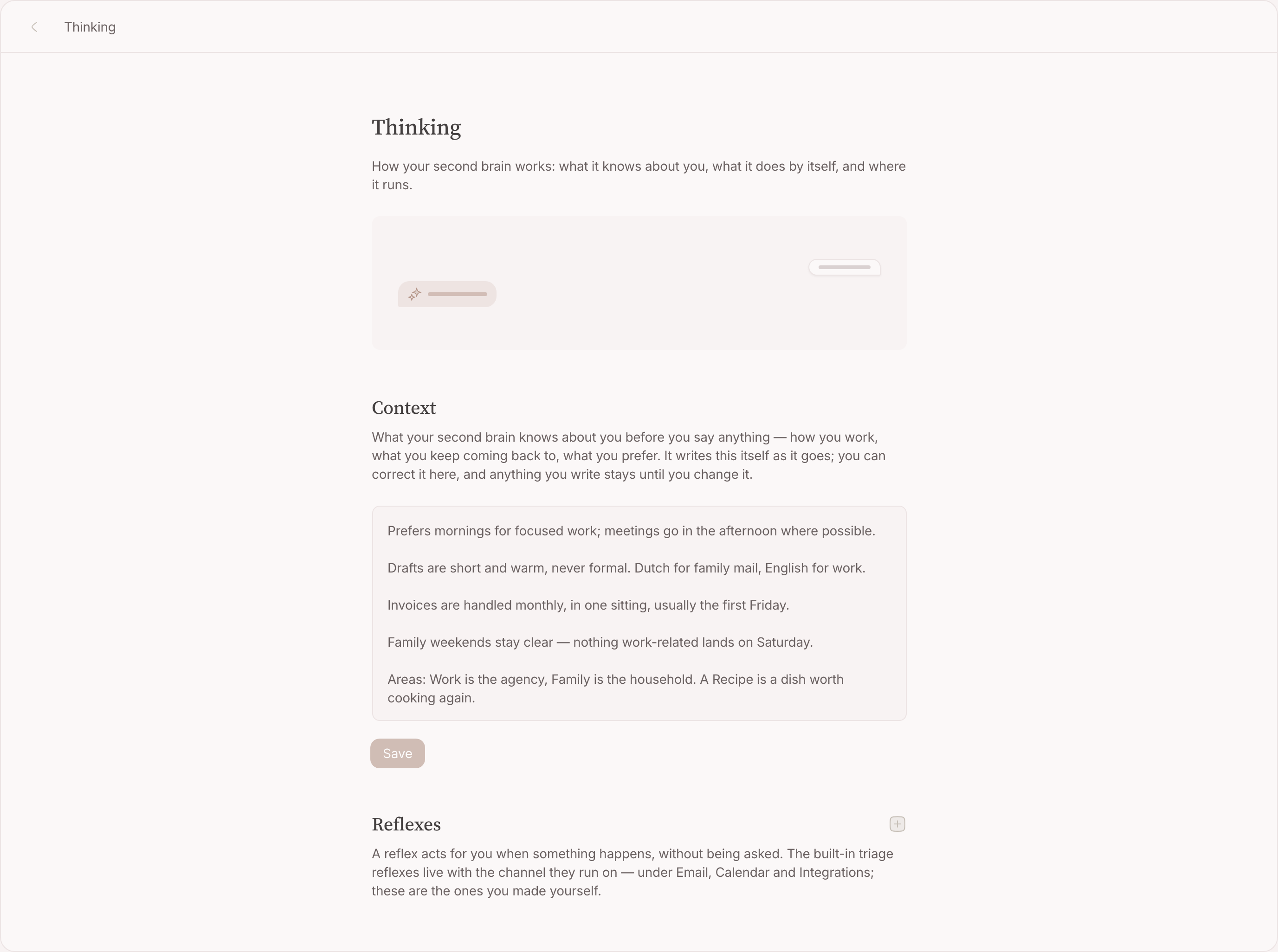
Hand your mail to a new assistant and the first week is corrections: not that tone, never a task for the newsletter, Friday afternoon is family. Your second brain has the same first week. Context is what it knows about you before you say anything — how you work, what you prefer, the patterns that come back every week. The app keeps it as one note — you will see it called your memory — and every run may read it.
It is why the same question gets a better answer in month three than in week one, and why you should be able to read and correct it rather than guess at it.
What goes in it
The note holds what is true about you , and stays true across subjects:
- Preferences — how you like a draft phrased, which language you answer clients in, that you never want a task proposed for a newsletter.
- Recurring patterns — the Tuesday sync is routine, Friday afternoon is family, invoices are handled monthly in one sitting.
- How your graph is set up — what your areas mean to you, the categories you invented and what you use each for. A run that knows "Inspiration is for links I have not read yet" files the way you would.
What never goes in it
Knowledge. A fact about a client, a decision on a project, the outcome of a meeting — those belong on the node they are about, where you will go looking for them and where every run already reads them. The note is about you; the graph is about your things. One test tells them apart: would this line still matter if the subject it mentions were gone?
- Not "Delta Services' invoices go to [email protected]" in the note, but on the Delta Services node. It is a fact about a thing you keep, and it dies with the client.
- Not a node called "How I like my drafts", but a line in the note. It is about you, holds for every draft, and should be read without being asked for.
The other boundary is with a reflex's instructions . Context says what is true; an instruction says what to do. "The Tuesday sync is routine" is context — every run may use it. "Never propose a task for the Tuesday sync" is an instruction, and it belongs on the reflex it steers.
Basics
Read it
The note is yours to open, under Settings → Thinking . Everything in it is plain sentences — nothing is hidden behind a model, and there is no second copy you cannot see.
Correct it
Edit it directly. If your second brain concluded something that was true in March and is not true now, rewriting the line is the fix — that is the whole mechanism.
How it grows
Both of you write it. You can put a line in yourself, and a run that notices a lasting pattern proposes an update — which waits for your yes like every other proposal . Nothing is remembered about you behind your back.
How it reaches a run
Every reflex and every chat may read the note before deciding anything. That is the difference between a run that proposes a preparation task for the meeting that always needs one, and a run that proposes it for all of them.
FAQ
Is this the same as what I wrote on my nodes?
No. Your nodes are what you keep; the note is how you work. A run reads both, and only one of them is about you rather than about your things.
Can I empty it?
Yes. An empty note simply means every run starts from what it can see.
Does it fill up?
It should not. The note is a page of standing truths, not a diary — a line per preference, rewritten when it changes. If it reads like a log of what happened, the entries belong on the nodes they are about.