Locations
Look up an address, or drop a pin where the world has none.
Overview
You are standing in front of the restaurant your colleague dragged you to, and you already know two things: you will want to come back, and in three months you will not remember what it was called. That is the moment a place is kept. A place is a source like any other: it hangs on a node, and the node is what names it. The restaurant is not called "Bar Nou" because the pin says so — it is called that because the note you wrote says so.
Basics
Look up an address
- Open the map and start a search.
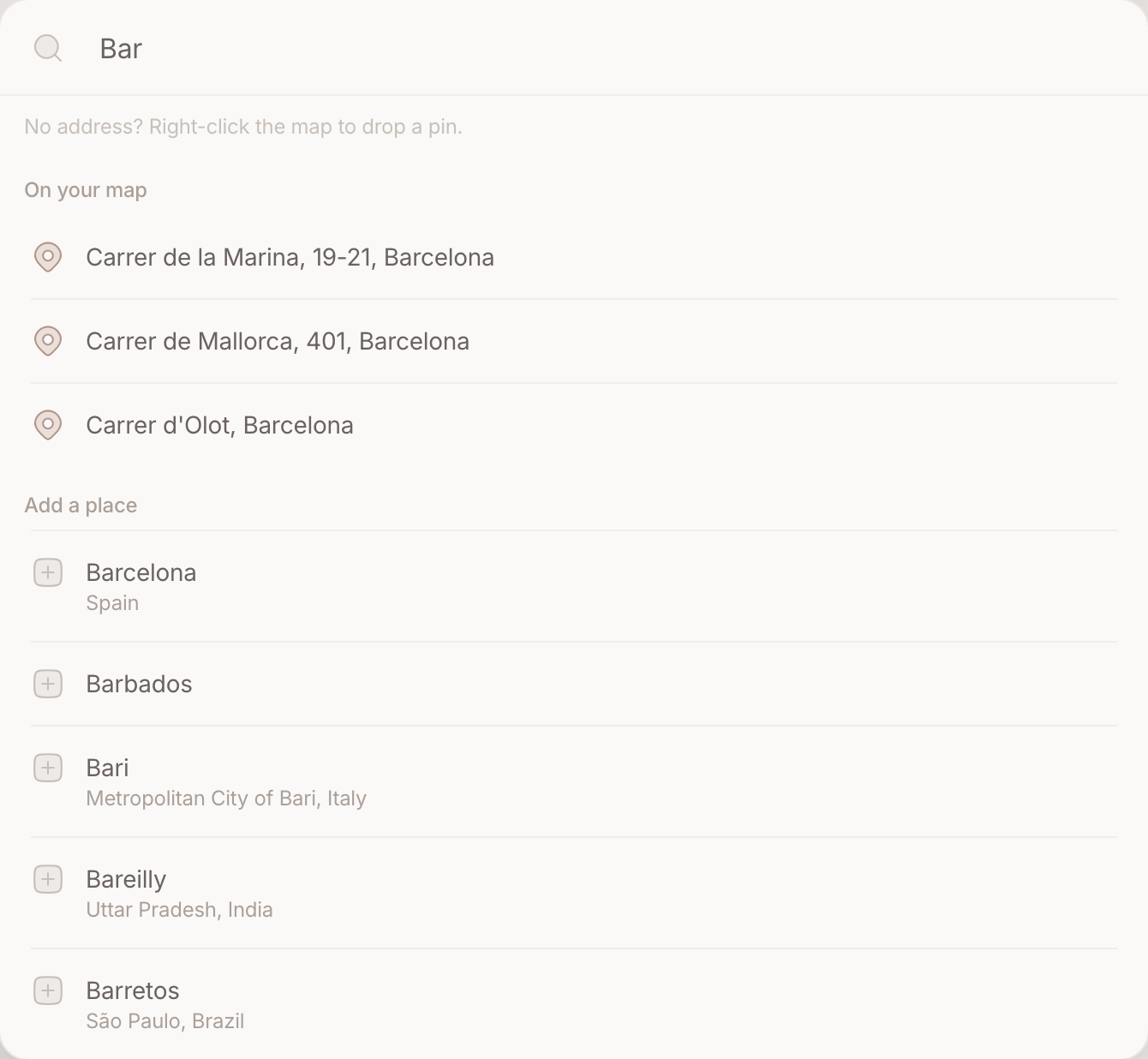
- What you already keep is listed first, narrowing the map as you type. Under Add a place come the addresses you have no pin for.
- Pick one. The map flies there and the street is filled in for you.
- Say what it belongs to — the same search-or-create field your lists carry, so the note you wrote a minute ago is standing there waiting.
Drop a pin
For the bench, the trailhead, the door round the back: right-click the map, or press and hold on a touchscreen, and a plus appears where you pressed. Nothing fills in a street for a spot the world has no address for, so write what would get you back there — "behind the church, by the water" is a perfectly good address.
From the node instead
The sources section on a node offers Location and lists the places you already have. Useful when the pin exists and the note is the new half.
Which node should it be?
A place is the one kind that cannot say what it is. An event tells itself apart by its date and a mail by its subject, but a place has only its address — the node it hangs on is its name . That makes the question sharper here than anywhere else.
One of a kind hangs directly
The family's home is a place on the family node. A company with one office carries its own pin. There is nothing to tell apart, so nothing has to be minted: no "Head office" node while there is one office.
Two you must tell apart become nodes
The moment there is a second, each becomes a node of its own — one per branch, related to the company, each carrying its own place. Two pins on one node can say where they are, but not which branch is which.
Mint the branch nodes the day there is a second, not in advance. Structure laid out ahead of the facts is a filing cabinet.
FAQ
Can one place hang on several nodes?
Yes. A client's office is one place with a dinner, a workshop and a contract hanging off it — which is a history of a room rather than an address.
What about photos?
A photo carrying GPS puts its place on the map by itself, hanging on the node you attached it to. Move the photo and the pin moves with it.